The Snack Potluck Patch Swap

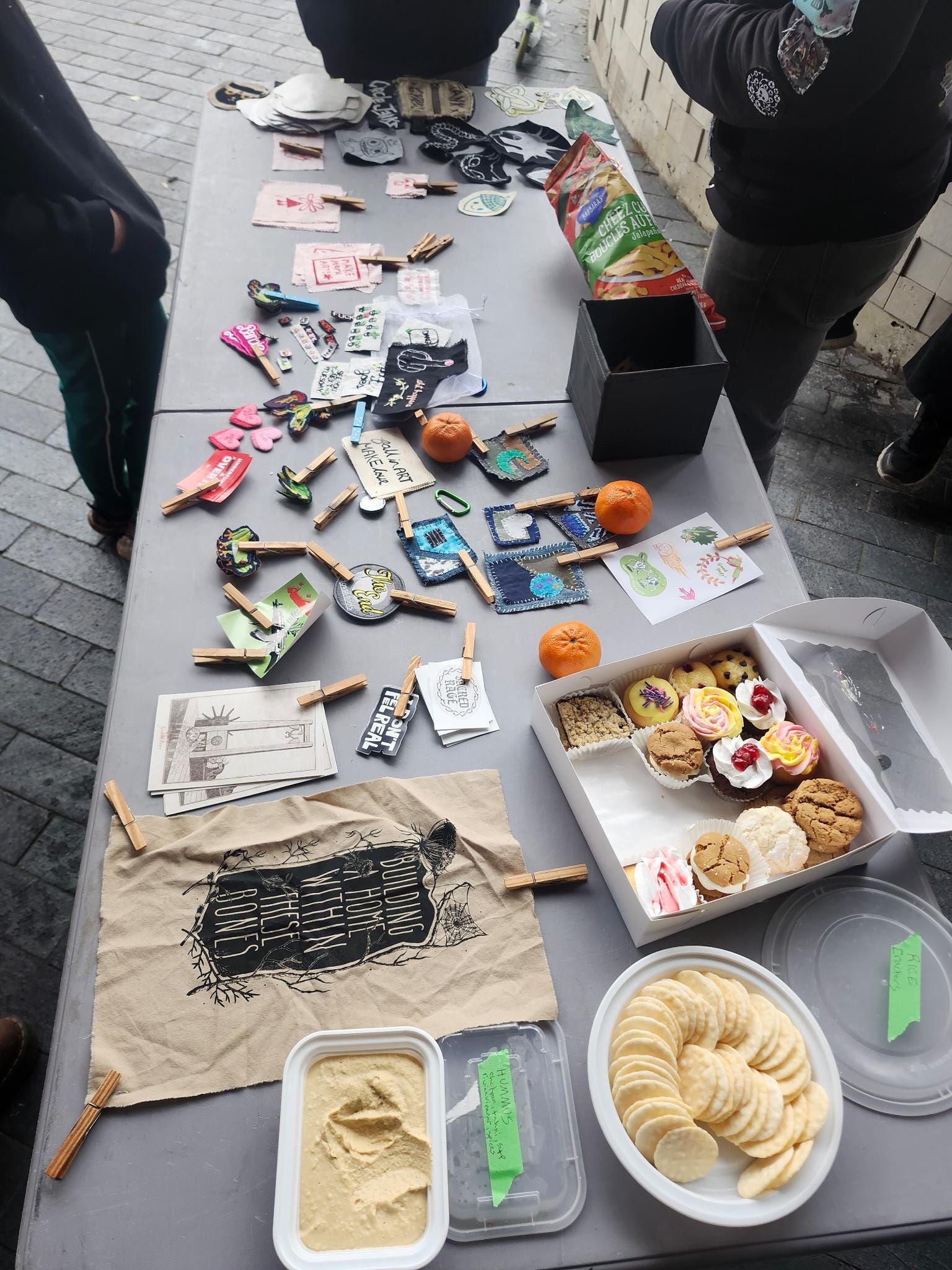
Yesterday I held a snack potluck patch swap. I had been inspired by online friends who had held a patch swap (I threw the snack potluck in there myself because who doesn’t love sharing snacks) and put a call out on Instagram to see if there was local folks who might be interested in participating.
This isn’t my first foray into grassroots community organizing, if you can even call it that. The fact that basic social gatherings are now considered community organizing is a testament to how desperate these times have become. Dinners with friends, regular potlucks, even standing friend dates feel like a political response to the extreme isolation we find ourselves in as a result of unfettered colonial capitalism.
The snack potluck patch swap was pretty magical. Local people that I had never met but connected with on social media gathered under the awning in front of city hall for an hour and a half on a rainy Saturday afternoon. Many brought friends. Some brought food, some brought handmade patches and other artwork. Everyone ooohed and aaaahed at how much we loved each other’s art. We talked loosely about politics but more about life: kids and work and friends in common. We took up space in a place that should rightfully belong to the community, and no one bothered us: a multi generational gathering of local queer punks.
Hopefully other casual gatherings will follow, but even if they don’t, those threads of community have still been woven together. Instagram handles were exchanged and we all connected in a group chat. This is foundation building work.
If I’m being honest, I really love hosting gatherings like this. They’re low key, open and accessible, totally disconnected from capitalism, and required almost no investment, either financial or emotional. They’re low stress, largely because I have low expectations but when they land well, like the gathering yesterday, they fill a social battery that rarely gets charged for me. I come home exhausted but with a sense of hope.
I’ve written before about our standing monthly potluck: the first Saturday of the month, we invite people to gather in our home to share food. It’s been met with mixed results. I tell myself that the right people always come and I believe that honestly. But the low turnout often makes me feel deflated, not because I’m disappointed in the people, but the systems that keep them exhausted.
Gathering and connecting right now honestly takes time and energy. It takes dedication and effort. We are fighting both exhaustion from existing under capitalism and the normalization of isolation through social media: the promise of human connectivity that always falls short. I read a fantastic article from Pamela Cantor this week about the difference between dopamine and oxytocin on brain development and it’s got me thinking hard about how we have woven this tapestry of online and offline social engagement into our modern lives.
When I think about my social life a decade ago, it’s so vastly different from what it looks like today. I don’t drink, which is one of the barriers because so much of our adult social activity is centered around bars and alcohol consumption. But more than that, my energy is so limited that I have a hard time committing to more than a few events a week. So much is taken up by work. And as someone who spent years making my own hours, I can easily attest to the exhaustion and disconnection that accompanies selling half my day to someone else.
These barriers are not my fault, nor is it the fault of others when they don’t show up to the potluck. These basic social gatherings are now strenuous to attend under capitalism. Remember: we blame the systems, not the people.
This dichotomy of online versus IRL social engagement is a problem of our times to be sure. I was listening to an Instagram reel the other day (I can’t remember who) that cited studies showing how our isolation in itself isn’t the issue, but the fact that we don’t actually feel lonely even though we are technically isolated is the concerning issue. As a whole, we seem largely unconcerned that our lives lack the human connection that we depend on physiologically. We are too distracted with doing all the other things that we need to do in order to survive under capitalism. Either that, or we’re listening too closely to the propaganda that tells us our co-dependency with other humans is considered a weakness.
I’m finishing the piece while sitting at the gym while my son does a gymnastics class. I am looking around at all the human connect that is happening in this space. While we technically still connected, I can’t help from filtering all this engagement through my anti-capitalist lens. We pay for classes. Students are expected to follow instructions from teachers and behave appropriately. There is the expectation of performance and kids that do better are rewarded while the ones who struggle feel ashamed. I think if we were to examine many of our so-called social institutions, we’d find the same analysis would produce similar results.
This is why the low-key, low-commitment, free-to-attend, accessible community gatherings are so politically charged right now. This is why the multi generational local queer punks matter to me. Even though many of these attempts flop, it’s also why I’ll keep putting myself out there and trying to bring people together to create connection and community.